
EHR for Small Dietitian Practices: How to Choose the Right System for You
Obtaining an EHR for a small nutrition practice is one of those things most dietitians do not think about on day one because when you are starting out, paper notes, Google Docs, or a basic spreadsheet feel totally fine and honestly kind of charming. But as your practice grows, clients increase, and your time gets tighter, those manual systems start to feel messy, slow, and stressful, and suddenly you are spending more energy managing information than actually coaching nutrition.
The shift from paper or scattered files to a streamlined digital system is not about being fancy, it is about protecting your time, improving the client experience, and making sure your practice stays compliant and organized as you scale. The right EHR can simplify documentation, scheduling, and communication while helping your business feel more professional and secure. In this post, we will talk about when it makes sense to upgrade, what features actually matter for dietitians, and how to compare some of the best EHR options designed specifically for small practices.
What Is an EHR and Why Does Your Dietitian Practice Need One?
An EHR (Electronic Health Record) is a digital system that stores and manages all of your client information—everything from intake forms and charting to scheduling and secure messaging. Think of it as the central hub for your practice: no more digging through notebooks, chasing down emails, or rifling through folders to find that one sticky note with a food recall detail.
For dietitians, the benefits go well beyond replacing paper. A good EHR provides secure documentation, streamlined scheduling, and organized client communication, and many systems also include helpful extras like food journaling, meal planning tools, and even AI-assisted note taking to speed up your workflow. Most importantly, EHRs help your practice stay HIPAA compliant, protecting sensitive health information and keeping your business on the right side of regulations.
Here’s a real-life example from a dietitian before she made the switch: before joining The Foundation®, my client Jane was juggling Google Docs, scribbled paper notes taken during sessions, and email chains for scheduling. Every week was a battle of “Wait, is 2pm still good?” and she felt frazzled before she even walked into a session. After implementing an EHR tailored to her needs, all of that changed—no more back-and-forth emails, customizable note templates that cut charting time, and a sense of calm she didn’t realize she was missing. She showed up more present with clients and spent way less time buried in admin—exactly the kind of transformation a good EHR can deliver!!!
Signs It’s Time to Upgrade to an EHR
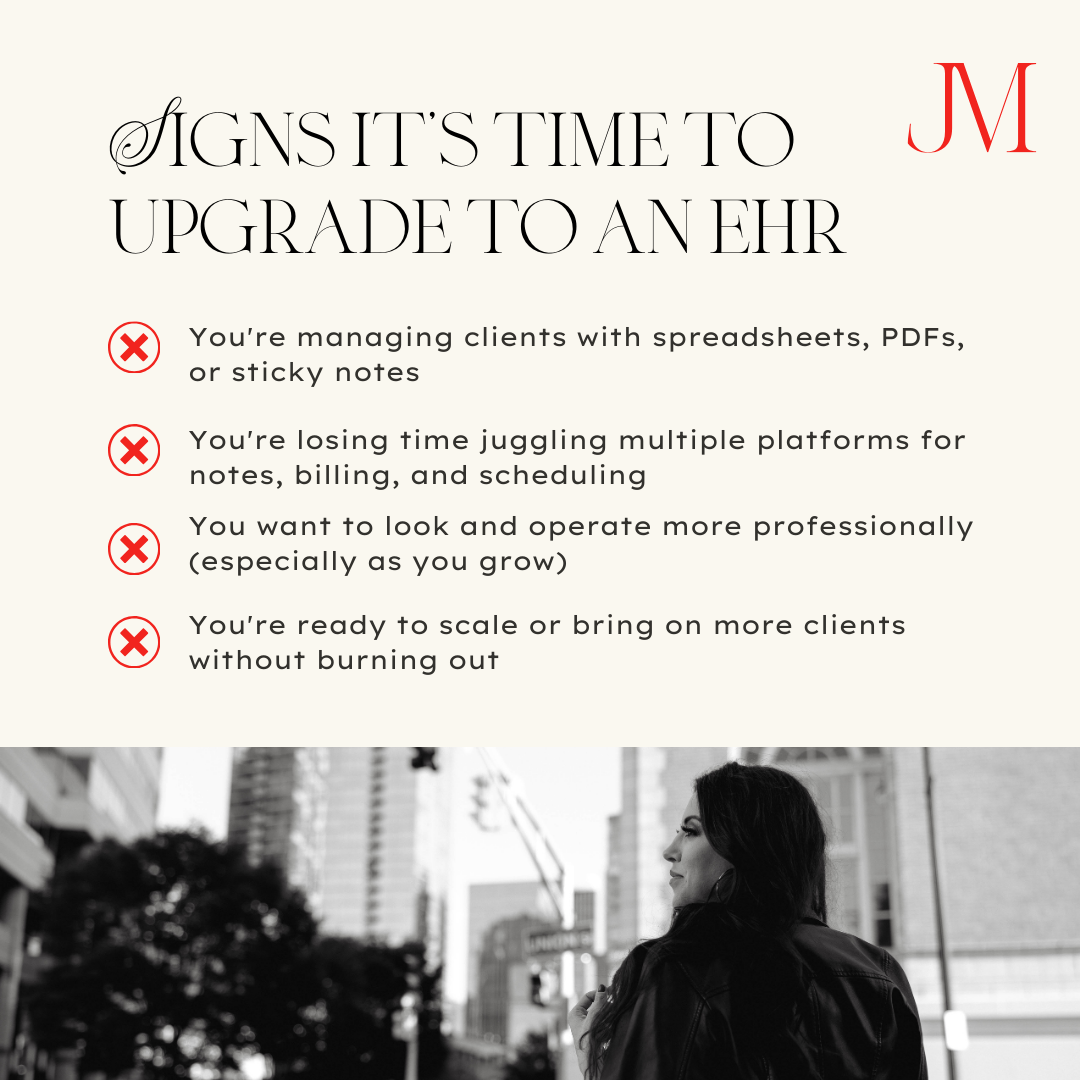
Signs it’s time to upgrade to an EHR usually show up long before things feel fully out of control. If your systems are starting to feel clunky or you are constantly playing catch up behind the scenes, your practice is probably telling you it is ready for something more streamlined.
You’re managing clients with spreadsheets, PDFs, or sticky notes
If client information lives in five different places and at least one of them is a notebook on your desk, it becomes harder to stay organized and confident. Manual tracking increases the risk of missed details and makes simple tasks take way longer than they should.
You’re losing time juggling multiple platforms for notes, billing, and scheduling
Switching between tools all day drains energy fast. When your notes are in one system, scheduling in another, and billing somewhere else, admin work quietly eats into the time you could be spending with clients or growing your business.
You want to look and operate more professionally, especially as you grow
An EHR instantly elevates how your practice feels to clients. Online scheduling, digital forms, and secure messaging create a smoother, more polished experience that builds trust and credibility from the start.
You’re ready to scale or bring on more clients without burning out
Growth should not mean longer nights and endless charting. The right EHR supports higher client volume with better workflows, templates, and automation so your practice can expand without taking your energy down with it.
What to Look for in an EHR for a Small Dietitian Practice
Choosing the right EHR isn’t just about picking the most popular name—you want a system that actually fits your workflow, your clients, and your growth goals. Here are the key qualities that make an EHR worth investing in for a small dietitian practice:
HIPAA-compliant security and data storage
Protecting client information isn’t optional—it’s essential. Make sure your EHR stores data securely and meets HIPAA standards so you can confidently handle sensitive health details without worrying about compliance issues.
Easy-to-use interface with minimal tech learning curve
You don’t need a complicated tool that doubles as a part-time job to learn. A clean, intuitive interface means you spend less time troubleshooting and more time doing the work you love.
Integrated features: charting, scheduling, billing, forms, telehealth
The more you can do in one place, the better. Look for an EHR that brings together your everyday needs—client notes, appointment booking, billing, intake forms, and virtual visits—so you’re not hopping between platforms.
Customization options for nutrition-specific templates and workflows
Dietitians don’t work like every other clinician, so having the ability to tailor templates and workflows to your practice makes documentation faster and more accurate, whether it’s meal plans, ADIME notes, food logs, or client health goals.
Scalable pricing that works for solo or small teams
You want pricing that fits where you are now, but doesn’t make you pay through the nose as you grow. Look for flexible plans that support solo practitioners and expand reasonably if you bring on RD associates.
Excellent customer support and onboarding resources
A great EHR is only as good as the support behind it. Responsive customer service and helpful onboarding materials can make all the difference when you’re transitioning systems or training your team.
Four Common Mistakes Dietitians Make When Choosing an EHR
Picking an EHR is a big decision, and it’s easy to get swept up in flashy features or industry hype. Here are some of the most common missteps dietitians make and how to avoid them!
Overpaying for features they don’t use. It’s tempting to grab the most robust plan you see, but if you’re paying for advanced modules you’ll never touch, your budget suffers for no real benefit. Focus first on what you actually need now and what will genuinely save time or improve workflows.
Choosing a system built for doctors, not dietitians. Many EHRs are designed for general clinical practices and don’t consider the unique documentation dietitians rely on—like ADIME note formats, meal planning, food journaling, or nutrition-specific workflows. Make sure the system you choose actually works the way you do.
Not considering long-term needs as the practice grows. Your practice won’t stay exactly how it looks today forever. If you plan to bring on another RD, run group programs, or expand services, choose a system that can grow with you rather than force a painful switch later.
Skipping a trial period or not fully exploring the platform. Trying an EHR before you commit is huge. If you skip the trial or only skim features, you could end up stuck in a system that doesn’t feel intuitive or doesn’t actually solve your biggest pain points. Some platforms, like Practice Better with its free Sprout plan, let you test the basics and see how it fits before investing. Exploring hands-on will save frustration (and money) down the road.
How to Choose the Best EHR for Your Dietitian Business
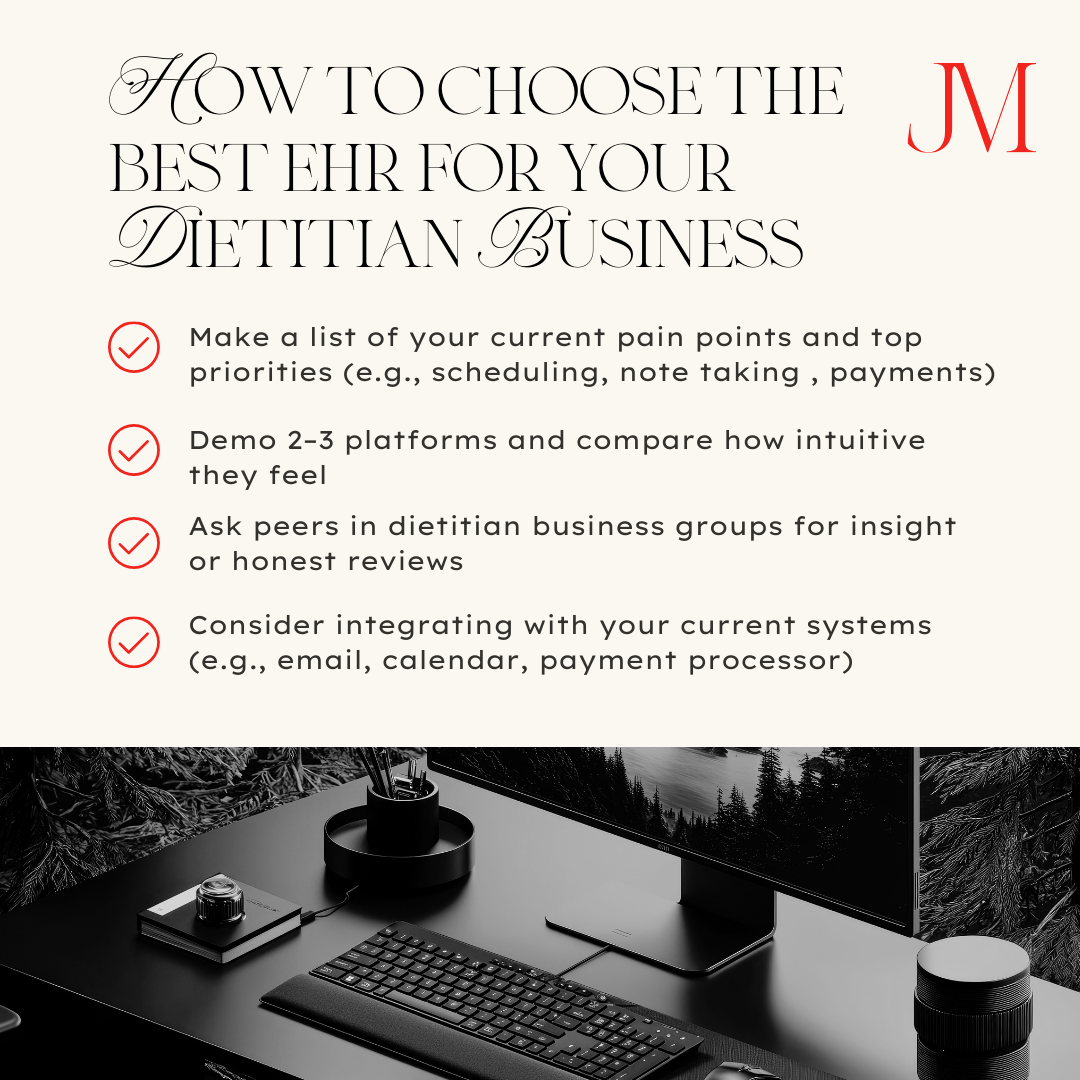
Choosing the best EHR for your dietitian business starts with getting really honest about what is not working right now. Make a short list of your biggest pain points and top priorities, whether that is smoother scheduling, ADIME-style notes, easy payments and invoicing, or better client messaging. This helps you focus on solutions instead of getting distracted by features that look impressive but do not actually fix your day-to-day frustrations.
Next, demo two or three platforms and pay close attention to how intuitive they feel. You should be able to imagine yourself using the system on a busy day without wanting to throw your laptop across the room. There are great comparison posts out there that break down options side by side, but my top recommendation for most dietitians is Practice Better because it is built specifically with nutrition professionals in mind and grows well with your business.
It is also smart to ask peers in dietitian business groups for honest feedback. Other RDs are usually very open about what they love, what they tolerate, and what they would never choose again, and that real-world insight is often more helpful than marketing pages.
What Success Looks Like with the Right EHR
When you choose the right EHR, the impact shows up fast and in ways you feel every single week. It is not just about having better software, it is about creating a practice that runs smoothly and supports you instead of draining you. Here are some signs you chose the right EHR:
Your clients receive automated intake forms and appointment reminders
Clients know exactly what to expect before sessions, paperwork is done ahead of time, and fewer appointments slip through the cracks. It feels professional and saves everyone time.
You spend less time on admin and more time with clients
With scheduling, messaging, and billing handled in one place, your brain is no longer juggling logistics all day. That mental space goes back to coaching, connecting, and growing your business.
Charting takes minutes, not hours
Templates and streamlined notes mean you are not rewriting the same information over and over. You finish charts faster and actually close your laptop at the end of the day.
You feel confident about documentation, compliance, and workflow
Knowing your system is secure and HIPAA compliant brings peace of mind. Everything has a place, and you trust that your practice is protected and organized.
FAQs About EHRs for Small Dietitian Practices
Do I really need an EHR if I only see a few clients per week?
Not necessarily. If you are seeing just a handful of clients, you can absolutely get by without a full EHR. Tools like Google Workspace can help you keep notes organized and HIPAA compliant when set up correctly, and some platforms like Practice Better offer a free Sprout plan that gives you EHR functionality without a big commitment.
How much should I expect to pay for an EHR?
Most EHRs for solo dietitians start around $25 per month and can go up to $200 or more as you add features or bring on additional RDs. Pricing usually depends on how many clients you see, whether you need billing tools, and if you are running a team or group programs.
Can I use something like Google Docs or is that a HIPAA risk?
Google Docs can be HIPAA compliant, but only if you are using Google Workspace and have it properly configured. This includes restricted access, strong internal policies, staff training, and a signed Business Associate Agreement with Google. Using a free personal Google account does not meet HIPAA requirements.
What’s the difference between an EHR and an EMR?
An EMR, or Electronic Medical Record, is typically used within a single practice and focuses on internal documentation. An EHR, or Electronic Health Record, is more comprehensive and designed to support client care over time, often with features like client portals, messaging, integrations, and data sharing when appropriate. For private practice dietitians, EHRs are usually the better fit.
Are there EHRs built specifically for dietitians?
Yes, and this is where choosing the right system really matters! Platforms like Practice Better, Healthie, and Kalix are designed with nutrition professionals in mind and include tools like ADIME notes, food journaling, meal planning, and client messaging that generic medical systems often lack.
Final Thoughts: Your Practice Deserves Systems That Work for You
An EHR is not just another piece of tech to figure out, it is a business investment that supports how you work, how your clients experience your care, and how sustainable your practice feels long term. The right system should reduce stress, protect your time, and help your business run more smoothly behind the scenes.
As you choose or upgrade your systems, aim for tools that make your work easier, not harder. If an EHR feels confusing, clunky, or adds more steps to your day, it is probably not the right fit. Your systems should support your expertise, not compete with it. It is also a good idea to review your tools every six to twelve months as your practice grows. What worked when you had five clients a week may not work when you are fully booked, running programs, or bringing on support. Giving yourself permission to evolve your systems is part of scaling with intention.
And if you are an RD who wants help getting your business off the ground and streamlining your systems from the start, The Foundation® was built for you. Inside, you get guidance, structure, and support to set up your practice in a way that feels organized, professional, and sustainable from day one.
This post/site contains affiliate link(s). When you click and make a purchase and/or sign up at a site through a link I've provided, I may make a small commission on your purchase at no additional cost to you.